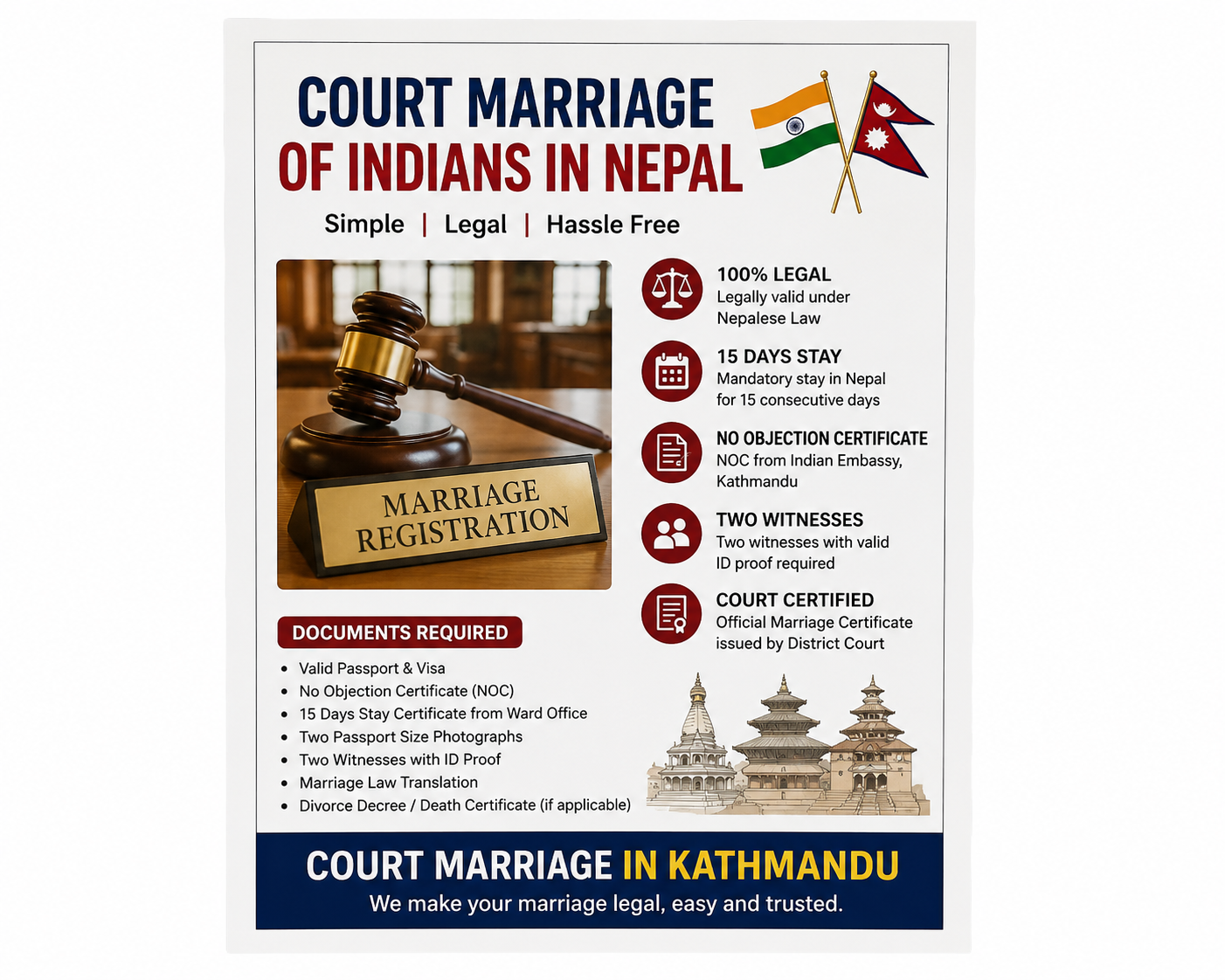
Every year, hundreds of Indian couples choose court marriage in Nepal because of its straightforward legal process, international recognition, and proximity to India. Whether you belong to different religions, different states, or simply wish to have a legally registered marriage in a neutral jurisdiction, Nepal provides a reliable legal framework.
However, many couples are unaware that Indian citizens must fulfill specific legal requirements before getting married in Nepal, including a mandatory 15-day stay and obtaining a No Objection Certificate (NOC) from the Embassy of India.
This comprehensive guide explains everything you need to know about court marriage in Kathmandu, Nepal for Indian citizens, including eligibility, required documents, legal procedure, timeline, and recognition of the marriage in India.
Why Choose Court Marriage in Kathmandu?
Indian couples choose Nepal for several reasons:
- Simple and transparent legal procedure
- Marriage legally recognized under Nepalese law
- Suitable for inter-state and interfaith couples
- Internationally accepted marriage certificate
- Easy accessibility from India
- Professional legal assistance available throughout the process
Nepal has become one of the preferred destinations for couples seeking a legally valid civil marriage.
Is Court Marriage in Nepal Legal for Indian Citizens?
Yes.
Indian citizens can legally marry in Nepal under the provisions of the Nepal Civil Code, provided they satisfy all legal requirements prescribed by Nepalese law.
The marriage certificate issued by the Nepalese Court is an official government document and can be used for various legal purposes, including visa applications, immigration, spouse sponsorship, and other international documentation.
Eligibility for Court Marriage in Nepal
Before applying for marriage registration, both parties must satisfy the following conditions:
Minimum Age
Both the bride and groom must be at least 20 years old.
No exceptions are permitted under Nepalese law.
Marital Status
Both applicants must be:
- Single (never married)
- Legally divorced
- Widowed
If previously married, the divorce decree or spouse’s death certificate must be produced.
Mandatory Residence Requirement
One of the most important legal requirements is the mandatory 15 consecutive days of residence in Nepal before filing the marriage application.
This requirement cannot generally be waived.
Documents Required for Court Marriage in Nepal
Indian citizens should prepare the following documents before beginning the marriage process.
1. Valid Passport
Both parties must provide:
- Original passport
- Valid Nepal entry stamp
- Valid visa (if applicable)
2. No Objection Certificate (NOC)
A No Objection Certificate (Single Status Certificate) must be obtained from the Embassy of India in Kathmandu.
The NOC confirms that:
- The applicant is legally free to marry.
- The Government of India has no objection to the proposed marriage.
This is one of the most important documents required by the Nepalese Court.
3. Temporary Residence Certificate
After completing the required 15-day stay in Nepal, applicants must obtain a Temporary Residence Certificate from the local Ward Office.
This certificate confirms compliance with the residency requirement.
4. Translation of Indian Marriage Law
Applicants must submit a notarized English or Nepali translation of the relevant Indian marriage legislation, such as:
- Hindu Marriage Act
- Special Marriage Act
- Other applicable personal laws
The translation assists the Nepalese Court in verifying the legal capacity to marry.
5. Witnesses
Two witnesses are required during the court proceedings.
Each witness should carry valid government-issued photo identification such as:
- Indian Passport
- Voter ID Card
- Other accepted government identity documents
6. Passport Size Photographs
Carry approximately 4–6 recent passport-sized photographs of both parties.
7. Divorce Decree (If Applicable)
Applicants previously married must submit:
- Original divorce judgment
- Certified copy (if required)
Widowed applicants should produce the spouse’s death certificate.
Step-by-Step Court Marriage Process in Nepal
The procedure generally follows these stages.
Step 1: Arrive in Nepal
Both parties enter Nepal using valid passports.
The 15-day residency period begins from the date of arrival.
Step 2: Complete the Mandatory 15-Day Stay
Applicants must remain continuously in Nepal for fifteen days.
This residency is necessary before obtaining the Ward Certificate.
Step 3: Obtain Temporary Residence Certificate
After completing the required stay, visit the local Municipal Ward Office to receive the Temporary Residence Certificate.
Step 4: Obtain the No Objection Certificate
Apply for the No Objection Certificate at the Embassy of India in Kathmandu.
Processing time may vary depending on embassy procedures.
Step 5: File Marriage Application
Submit all required documents before the appropriate District Court in Nepal.
The application is examined for legal compliance.
Step 6: Sign the Deed of Consent
Both applicants and two witnesses appear before the Marriage Registration Officer.
Each person signs the Deed of Consent confirming free and voluntary marriage.
Step 7: Court Hearing
The judge verifies:
- Identity of both applicants
- Age
- Free consent
- Documents
- Legal eligibility
The judge may ask a few routine questions before approving the marriage.
Step 8: Marriage Certificate Issued
Upon approval, the District Court issues the official Marriage Certificate.
This certificate serves as legal proof of marriage.
How Long Does the Entire Process Take?
Typically:
- Mandatory stay: 15 days
- Documentation and court procedure: 2–5 working days
Overall, couples should plan approximately 18–21 days in Nepal.
Is the Marriage Valid in India?
Yes.
A marriage legally registered in Nepal is generally recognized in India.
After receiving the Nepalese Marriage Certificate, couples may:
- Authenticate the certificate (if required)
- Register the marriage in India under the Foreign Marriage Act, 1969
- Use the certificate for visa, immigration, banking, insurance, and other legal purposes
Registering the marriage in India provides additional administrative convenience, although the Nepalese marriage itself remains legally valid.
Benefits of Court Marriage in Nepal
Indian couples choose Nepal because it offers:
- Legally recognized marriage
- Transparent legal process
- Government-issued marriage certificate
- International acceptance
- Convenient location for Indian citizens
- Professional legal assistance throughout the procedure
Common Mistakes to Avoid
Many applications are delayed because applicants:
- Do not complete the mandatory 15-day stay
- Arrive without obtaining the required NOC
- Carry incomplete documentation
- Bring witnesses without valid identification
- Submit untranslated Indian legal documents where required
Proper preparation helps avoid unnecessary delays.
Why Hire a Court Marriage Lawyer in Nepal?
Although the legal procedure is straightforward, professional legal assistance can help you:
- Prepare complete documentation
- Obtain required certifications
- Coordinate with government offices
- File the application correctly
- Schedule court appearances
- Minimize delays and procedural issues
A legal professional familiar with Nepalese marriage laws can make the process significantly smoother.
Frequently Asked Questions (FAQs)
Can two Indian citizens legally marry in Nepal?
Yes. Indian citizens can legally marry in Nepal after fulfilling all legal requirements under Nepalese law.
Is the 15-day stay compulsory?
Yes. Nepalese law requires a mandatory 15 consecutive days of residence before filing the marriage application.
Is a No Objection Certificate mandatory?
Yes. Indian citizens are generally required to obtain a No Objection Certificate from the Embassy of India in Kathmandu.
Can divorced persons marry in Nepal?
Yes. Divorced individuals may marry after producing the final divorce decree.
Are witnesses compulsory?
Yes. Two witnesses with valid photo identification must be present during the marriage registration process.
Is the Nepal marriage certificate accepted internationally?
Yes. The certificate issued by the Nepalese Court is generally accepted for immigration, visa, and legal purposes, subject to the requirements of the receiving country.
Conclusion
Court marriage in Kathmandu offers Indian couples a secure, transparent, and legally recognized way to solemnize their marriage. While the process involves specific legal requirements—such as the mandatory 15-day stay, obtaining a No Objection Certificate from the Indian Embassy, and appearing before the District Court—it is well-defined and can be completed efficiently with proper preparation.
If you are planning a court marriage in Nepal, ensuring that all documents are complete and following the prescribed legal procedure will help avoid unnecessary delays and make the registration process smooth and hassle-free.